Summary
Graph visualization is a cornerstone of network analysis, yet traditional algorithms often prioritize topological representation over the preservation of inherent node order. This can obscure sequential or procedural information critical in many scientific and structural analyses. This paper introduces the Keçeci Layout, a deterministic, order-preserving graph layout algorithm designed to arrange nodes in a structured zigzag pattern. This method provides a clear, predictable, and structurally informative visualization for systems where the sequence of nodes is meaningful. The layout is implemented in the open-source kececilayout Python package, which offers seamless interoperability with major graph analysis libraries, including NetworkX, igraph, rustworkx, Networkit, and Graphillion. kececilayout is open source, licensed under the MIT license, and the source code is available on GitHub at https://
Statement of Need
The visualization of complex networks is fundamental to understanding their structure, function, and underlying patterns. Algorithms such as force-directed layouts Fruchterman & Reingold, 1991 are highly effective at revealing topological features like clusters and central nodes. However, they achieve this by optimizing node positions to minimize edge crossings and regularize edge lengths, a process that inherently disregards any pre-existing order among the nodes.
To address this gap, the Keçeci Layout was developed as a structural approach for interdisciplinary scientific analysis Keçeci, 2025Keçeci, 2025Keçeci, 2025. It is a deterministic algorithm that explicitly preserves the order of nodes, arranging them in a predictable zigzag pattern Keçeci, 2025Keçeci, 2025. This approach moves beyond purely topological representations to provide a “structural thinking” framework, enabling clearer insight into ordered systems Keçeci, 2025. As described by Keçeci (2025), this paper describes the core principles of the Keçeci Layout, details its implementation, and highlights its utility in cross-disciplinary contexts.
The Keçeci Layout Algorithm
The Keçeci Layout is fundamentally a sequential algorithm that places nodes one by one according to their given order. Its defining characteristic is the combination of linear progression along a primary axis and an alternating, expanding offset along a secondary axis. This generates the distinctive zigzag shape Keçeci, 2025. The algorithm is deterministic: for a given list of nodes and a fixed set of parameters, the resulting layout is always identical Keçeci, 2025.
Algorithmic Principles
The position of each node is determined by its index in the sorted node list. Let be the ordered sequence of nodes. For each node at index , its coordinates are calculated based on four key parameters:
primary_direction: Defines the main axis of progression. It can be vertical (‘top-down’, ‘bottom-up’) or horizontal (‘left-to-right’, ‘right-to-left’).primary_spacing: The constant distance separating consecutive nodes along the primary axis.secondary_spacing: The base unit of distance for the offset along the secondary axis.secondary_start: Defines the direction of the first offset on the secondary axis (e.g., ‘right’ or ‘left’ for a vertical primary axis).
The core logic for a ‘top-down’ primary direction is as follows:
Primary Coordinate Calculation: The primary coordinate (in this case, ) is determined by the node’s index .
Secondary Coordinate Calculation: The secondary coordinate () is calculated based on an alternating and growing offset. The magnitude of the offset for node is proportional to , and its direction depends on whether is odd or even.
The node at index is placed at the origin of the secondary axis ().
This deterministic procedure ensures that nodes are arranged sequentially, making it easy to trace paths and understand flow while effectively utilizing two-dimensional space to avoid overlap. The graph-theoretic underpinnings of this structured approach facilitate cross-disciplinary inquiry by providing a common visual language Keçeci, 2025.
Implementation: The kececilayout Package
The Keçeci Layout algorithm is implemented and distributed as an open-source Python package named kececilayout. The package is designed for ease of use and seamless integration with the scientific Python ecosystem.
Availability and Installation
The package is available on both the Python Package Index (PyPI) and Anaconda, and its source code is hosted on GitHub. It can be installed using standard package managers:
Using pip:
pip install kececilayoutUsing conda (from the ‘bilgi’ channel):
conda install -c bilgi kececilayoutRelevant resources, including the source code and data sets, are publicly available Keçeci, 2025Keçeci, 2025Keçeci, 2025Keçeci, 2025Keçeci, 2025.
Interoperability and Usage
A key design goal of the kececilayout package is to provide a unified interface for various graph libraries. The main function, kececilayout.kececi_layout(), automatically detects the input graph type and returns a position dictionary in the format expected by that library. This promotes a cross-disciplinary graphical framework by allowing researchers to use the same visualization logic regardless of their preferred analysis tool Keçeci, 2025.
Supported libraries include:
NetworkX: The most popular graph analysis library in the Python data science community.
igraph: A high-performance library widely used in academic research.
rustworkx: A fast, thread-safe graph library written in Rust, often used in performance-critical applications.
Networkit: A library focused on high-performance analysis of large-scale networks.
Graphillion: A specialized library for very large sets of graphs.
The following example demonstrates how to apply the Keçeci Layout to a simple NetworkX path graph and visualize it with Matplotlib.
import networkx as nx
import kececilayout as kl
import matplotlib.pyplot as plt

# 1. Generate a graph (e.g., a path graph with 25 nodes)
G = nx.path_graph(25)

# 2. Compute the node positions using Kececi Layout
# The node order is preserved (0, 1, 2, ...)
pos = kl.kececi_layout(G, primary_spacing=1.5, secondary_spacing=0.8)

# 3. Visualize the graph
plt.figure(figsize=(8, 10))
nx.draw(
    G,
    pos=pos,
    with_labels=True,
    node_color='skyblue',
    node_size=500,
    font_size=8,
    edge_color='gray'
)
plt.title("Kececi Layout Applied to a Path Graph (n=25)")
plt.axis('equal') # Ensure aspect ratio is not distorted
plt.show()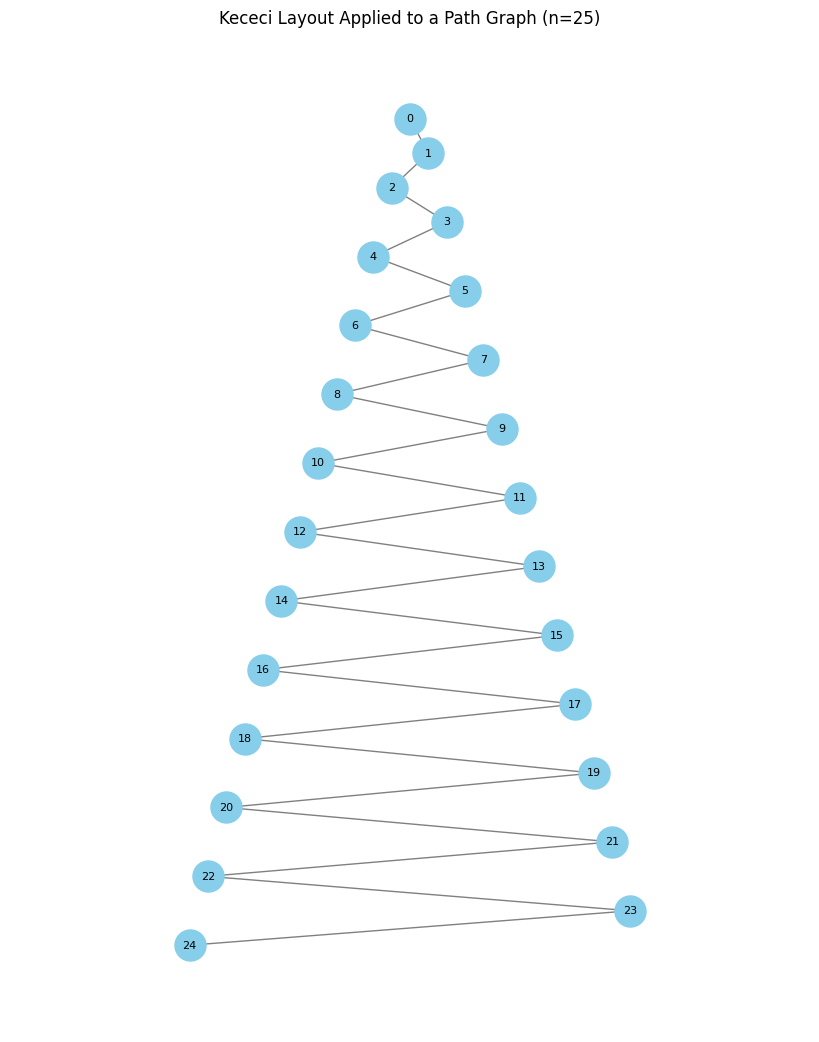
Applications and Use Cases
The primary strength of the Keçeci Layout is its ability to visualize systems “when nodes have an order” Keçeci, 2025. Its application is particularly relevant in fields where sequential data is modeled as a graph.
Workflow and Process Visualization: Representing business processes, experimental workflows Keçeci, 2025Keçeci, 2025, or CI/CD pipelines where the sequence of steps is paramount. The layout clearly shows the progression from start to finish.
Narrative and Structural Analysis: Analyzing the structure of stories, legal arguments, or scientific papers where nodes represent events, sections, or concepts in a specific order.
Time-Series and Event Logs: Visualizing sequences of events from logs or time-series data, where the temporal order must be maintained.
Comparative Structural Analysis: As a standardized graphical framework, it allows for the visual comparison of different ordered systems, fostering interdisciplinary insights Keçeci, 2025Keçeci, 2025.
By providing a stable and structured visual representation, the layout encourages a “structural thinking” approach, where the focus shifts from complex topological entanglements to the clear, sequential architecture of the system being studied Keçeci, 2025Keçeci, 2025.
Conclusion
The Keçeci Layout provides a much-needed alternative to traditional graph drawing algorithms for the visualization of ordered systems. Its deterministic, zigzag-based approach ensures that the inherent sequence of nodes is not only preserved but becomes the primary organizing principle of the visualization. This results in clear, predictable, and structurally informative diagrams that are easy to interpret.
The implementation of this algorithm in the user-friendly and interoperable kececilayout Python package makes it an accessible tool for a wide range of researchers and practitioners. By offering seamless support for dominant graph libraries, it serves as a robust, cross-disciplinary framework for structural analysis. Ultimately, the Keçeci Layout champions the idea that for many systems, visualization should go beyond topology to faithfully represent structure and order Keçeci, 2025.
Future Work
Future work will focus on extending the layout’s principles to three dimensions and developing adaptive spacing strategies for graphs with highly variable node density or connectivity.
- Keçeci, M. (2025). Kececilayout. Zenodo. 10.5281/zenodo.15313946
- Fruchterman, T. M., & Reingold, E. M. (1991). Graph drawing by force-directed placement. Software: Practice and Experience, 21(11), 1129–1164. 10.1002/spe.4380211102
- Keçeci, M. (2025). The Keçeci Layout: A Structural Approach for Interdisciplinary Scientific Analysis. Zenodo. 10.5281/zenodo.15792684
- Keçeci, M. (2025). The Keçeci Layout: A Structural Approach for Interdisciplinary Scientific Analysis. Figshare. 10.6084/m9.figshare.29468135
- Keçeci, M. (2025). The Keçeci Layout: A Structural Approach for Interdisciplinary Scientific Analysis. OSF. 10.17605/OSF.IO/9HTG3
- Keçeci, M. (2025). Keçeci Deterministic Zigzag Layout. WorkflowHub. 10.48546/workflowhub.document.31.1
- Keçeci, M. (2025). Keçeci Zigzag Layout Algorithm. Authorea. 10.22541/au.175087581.16524538/v1
- Keçeci, M. (2025). Beyond Traditional Diagrams: The Keçeci Layout for Structural Thinking. Knowledge Commons. 10.17613/v4w94-ak572
- Keçeci, M. (2025). The Keçeci Layout: A Cross-Disciplinary Graphical Framework for Structural Analysis of Ordered Systems. Authorea. 10.22541/au.175156702.26421899/v1
- Keçeci, M. (2025). Beyond Topology: Deterministic and Order-Preserving Graph Visualization with the Keçeci Layout. WorkflowHub. 10.48546/workflowhub.document.34.4
- Keçeci, M. (2025). A Graph-Theoretic Perspective on the Keçeci Layout: Structuring Cross-Disciplinary Inquiry. Preprints.org. 10.20944/preprints202507.0589.v1
- Keçeci, M. (2025). kececilayout [Data set]. WorkflowHub. 10.48546/workflowhub.datafile.17.2
- Keçeci, M. (2025). kececilayout. Python Package Index (PyPI). https://pypi.org/project/kececilayout/
- Keçeci, M. (2025). kececilayout. Anaconda Cloud. https://anaconda.org/bilgi/kececilayout
- Keçeci, M. (2025). kececilayout: A deterministic, order-preserving, zigzag-shaped graph layout algorithm. GitHub. https://github.com/WhiteSymmetry/kececilayout